Herzoslovakian royal restoration
The Secret of ChimneysHerzoslovakian royal restoration is the proposed return of monarchy to a republic born from revolution and royal murder. It is not simply a question of finding a king: rival claimants, foreign governments, oil concessions, a large loan, and the concealed identity of the apparent heir turn restoration into a contest over who will rule—and what that rule will cost.
From revolution to restoration
The restoration debate begins against the memory of the uprising that ended the previous monarchy. King Nicholas IV married Queen Varaga, a former Paris music-hall performer whose royal ancestry was fabricated; the marriage helped provoke public discontent in a country described as aristocratic and reactionary. An uprising stormed the palace, killed the king and queen, and proclaimed a republic. The republic endured, though political violence continued, including the assassination of presidents. Count Stylptitch, who had gone to Paris after the king’s assassination, remained committed to monarchy despite reported involvement in Balkan political intrigues.
Years later, reports of a royalist restoration brought the question back into public discussion. The Obolovitch dynasty was not assumed to be extinct: even though Nicholas IV had left no son, there were said to be numerous possible relatives. The uncertainty was therefore not only whether monarchy could return, but which member of the dynasty might receive the crown. At the same time, rumors that oil had been found in Herzoslovakia gave foreign interests a practical reason to take notice of the country’s politics.
Rival claimants and competing offers
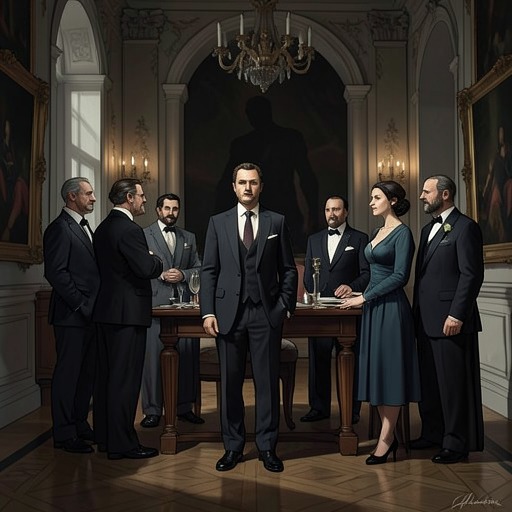
The immediate restoration scheme centers on Prince Michael Obolovitch. The people of Herzoslovakia are said to be prepared to restore the monarchy and offer him the crown, while the British Government supports his claim. George Lomax explains that a British company must secure the oil concessions and that the negotiations are to be conducted at Chimneys under the appearance of a shooting party. The political arrangement is tied to finance: Michael is prepared to grant concessions to Isaacstein and Co in return for a loan of roughly a million to help place him on the throne.
A rival path runs through Prince Nicholas. According to the financial account given to Superintendent Battle, Nicholas presented himself as a preferable choice to Michael because he was more sympathetic to modern, enlightened ideas. He invoked his early democratic views and sympathy for republican ideals while offering oil concessions to a group of American financiers in exchange for support. The competing offers expose the restoration’s central contradiction: a return to hereditary monarchy is being negotiated through claims of popular suitability, political sponsorship, and commercial advantage.
Succession crisis and concealed identity
The murder of Prince Michael turns the restoration negotiations into an urgent succession crisis. Battle observes that the sponsors have lost their prospective king and must find another quickly. Lomax and Herman Isaacstein acknowledge that the scheme is a major undertaking; when Battle asks who comes next in the line of succession, Lomax reluctantly identifies Prince Nicholas as the probable heir. Battle later confirms that Nicholas is Michael’s first cousin and the next heir to the throne.
Nicholas is believed to be in the United States, raising money on the expectation of his eventual position. That belief conceals the crucial complication: Nicholas is Anthony Cade. When Isaacstein asks whether Cade can produce the prince, Cade explains that Nicholas was reported killed in the Congo, but that he himself spread the report. He then identifies himself by Nicholas’s full name and offers to take the place of the prince whom Isaacstein had expected to meet. The restoration’s presumed heir has not been found abroad; he has been operating under another identity.
Political stakes and narrative significance
The proposed restoration links the country’s dynastic past to new struggles over oil, credit, and foreign influence. British backing for Michael and American financing for Nicholas are not abstract diplomatic positions: each is attached to a distinct promise about commercial concessions. The question of the crown therefore carries material consequences, while the haste to replace the murdered Michael exposes how dependent the scheme is on a narrow line of succession.
The episode also gives the novel’s disguise plot a constitutional consequence. Nicholas’s supposed death removes him from the political field, while his identity as Anthony Cade makes the apparent outsider the surviving heir. Restoration remains a plan under negotiation in the cited scenes, not a completed return to monarchy; what is established is the crisis surrounding the claim, the rival financial arrangements, and the revelation that the heir has been present all along under another name.